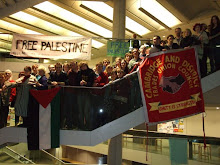
Join us in a continent-connecting adventure around the Cambridgeshire countryside:
Starting at: 12 o'clock-midday, Sunday 14th June
Meeting place & starting from: The Cafe Project, 22 Jesus Lane
100+ sponsored cyclists will together travel 3600km - the distance from Cambridge to Gaza – raising money to build empowering educational projects working with local NGOs in Gaza, the West Bank and Israel.
For more information visit:
http://cycletogaza.blogspot.com/
Thursday, 28 May 2009


Tuesday, 31 March 2009
Urgent petition to keep UEL open during G20 Summit
http://www.petitiononline.com/openUEL/
Dear friends,
the University of East London (UEL) was supposed to host analternative summit on April 1st in the context of the upcoming G20 meeting on April 2nd. Following the media and police hype about possible disruptions to the city, the University withdrew its support for the alternative summit.
Subsequently, management of the University decided to close down the university all together on April the 1st and 2nd, cancelling lectures and closing the library, effectively trying to turn the university into a wasteland in the very moment when the university should instead be up to the task of hosting critical debate and be a hub of creative energies.
As the text of the petition makes clear, this is not just about UEL,but about reclaiming universities and education in these times of crisis.
PLEASE FORWARD WIDELY -- PLEASE SIGN URGENTLY.
Open UEL Now collective
Dear friends,
the University of East London (UEL) was supposed to host analternative summit on April 1st in the context of the upcoming G20 meeting on April 2nd. Following the media and police hype about possible disruptions to the city, the University withdrew its support for the alternative summit.
Subsequently, management of the University decided to close down the university all together on April the 1st and 2nd, cancelling lectures and closing the library, effectively trying to turn the university into a wasteland in the very moment when the university should instead be up to the task of hosting critical debate and be a hub of creative energies.
As the text of the petition makes clear, this is not just about UEL,but about reclaiming universities and education in these times of crisis.
PLEASE FORWARD WIDELY -- PLEASE SIGN URGENTLY.
Open UEL Now collective
Friday, 27 March 2009
CGS holds Vigil for Peace Activist
We held a vigil in Cambridge on the 19th March outside the Guildhall, in solidarity with Tristan Anderson, who has been seriously injured by Israeli military forces during a non-violent protest against the 'separation' wall. It was also to show solidarity with the Palestinian people who experience daily brutality and oppression at the hands of the Israeli military, and many of whose deaths go unreported and uncontested. Tristan is currently in critical condition in hospital having been shot in the head with a tear gas canister.
Tristan is the good friend of a Cambridge student, who took part in our recent occupation at the University Law Faculty, and who regularly demonstrates peacefully alongside Palestinian people in West Bank villages, against the 'separation' wall, the confiscation of Palestinian land, the demolition of Palestinian homes and the oppression of Palestinian people. We seek to show our support to Tristan and to the people of Palestine for whom this violence is a commonplace reality of life under occupation.
http://www.democracynow.org/2009/3/16/us_consul_general_says_awaiting_israeli
http://www.guardian.co.uk/world/2009/mar/15/israel-hamas-gaza-weapons
Our vigil was covered in the Cambridge News here: http://www.cambridge-news.co.uk/cn_news_home/DisplayArticle.asp?ID=401488
Green Party Support
The following emergency motion was passed unanimously at the Green Party Spring conference in Blackpool. It is particularly apt in the light of the recent articles in the Guardian concerning human shields etc being used in the Gaza campaign (http://www.guardian.co.uk/world/2009/mar/23/israel-gaza-war-crimes-guardian).
5. Support for students
Item 4 of the Green Party Core Values states: "Electoral politics is not the only way to achieve change in society, and we will use a variety of methods to help effect change, providing these methods do not conflict with our other core principles."
In this spirit, and in recognition of the value of Non-Violent Direct Action, conference pledges its support to the students occupying University buildings across the country, and fully endorses their campaign to demand that universities divest both from the arms trade and other organisations which directly or indirectly have financially contributed to the military and economic oppression of the people of Gaza. Furthermore, conference condemns any universities taking disciplinary action against the occupying students who are exercising their right to protest; these students, as stakeholders in their University, have a valid right to demand that their university is investing funds ethically.
Conference thus calls for the following action to be taken: International committee and the International Coordinator to pledge support for the student campaign, and also to back our (Green) MEPs' call for an investigation into alleged Israeli war crimes in Gaza, in particular in light of recent revelations in the press about Israeli actions in Gaza.
5. Support for students
Item 4 of the Green Party Core Values states: "Electoral politics is not the only way to achieve change in society, and we will use a variety of methods to help effect change, providing these methods do not conflict with our other core principles."
In this spirit, and in recognition of the value of Non-Violent Direct Action, conference pledges its support to the students occupying University buildings across the country, and fully endorses their campaign to demand that universities divest both from the arms trade and other organisations which directly or indirectly have financially contributed to the military and economic oppression of the people of Gaza. Furthermore, conference condemns any universities taking disciplinary action against the occupying students who are exercising their right to protest; these students, as stakeholders in their University, have a valid right to demand that their university is investing funds ethically.
Conference thus calls for the following action to be taken: International committee and the International Coordinator to pledge support for the student campaign, and also to back our (Green) MEPs' call for an investigation into alleged Israeli war crimes in Gaza, in particular in light of recent revelations in the press about Israeli actions in Gaza.
Tuesday, 24 February 2009
DEBATE: ISRAEL/PALESTINE: WHAT SHOULD WE DO?
ISRAEL/PALESTINE : What should we do?
7.30pm
TUESDAY 24th
QUEENS' COLLEGE,
BOWETT ROOM
There is devastation in Gaza. Palestine remains blockaded and occupied. Rockets fire into Sderot and Ashkelon. We have born witness to years of conflict in Palestine and Israel. This country has played and continues to play it’s part in the story. This debate asks what we - as students and academics at UK universities and as UK residents - should be doing?
What is the right way forward? How, if at all, should we try to influence this process?
Four speakers will present their perspectives on what should be done, and on what we can and should do:
Betty Hunter— Palestine Solidarity Campaign
Jonathan Hoffman—Zionist Federation
David Massey—Anarchists Against the Wall
Dan Judelson—Jews for Justice for Palestinians Betty Hunter will open the debate, presenting the case for Boycott, Divestment and Sanctions.
Each speaker will make their case for 10 minutes and then the floor will be open for your questions.
These are important and sensitive issues, all are welcome, please inform friends and colleagues and please join us.
If you are a student, please bring uni ID. If you are not a university student then please contact Beccy at
7.30pm
TUESDAY 24th
QUEENS' COLLEGE,
BOWETT ROOM
There is devastation in Gaza. Palestine remains blockaded and occupied. Rockets fire into Sderot and Ashkelon. We have born witness to years of conflict in Palestine and Israel. This country has played and continues to play it’s part in the story. This debate asks what we - as students and academics at UK universities and as UK residents - should be doing?
What is the right way forward? How, if at all, should we try to influence this process?
Four speakers will present their perspectives on what should be done, and on what we can and should do:
Betty Hunter— Palestine Solidarity Campaign
Jonathan Hoffman—Zionist Federation
David Massey—Anarchists Against the Wall
Dan Judelson—Jews for Justice for Palestinians Betty Hunter will open the debate, presenting the case for Boycott, Divestment and Sanctions.
Each speaker will make their case for 10 minutes and then the floor will be open for your questions.
These are important and sensitive issues, all are welcome, please inform friends and colleagues and please join us.
If you are a student, please bring uni ID. If you are not a university student then please contact Beccy at
Statement on University Behaviour
Cambridge Gaza Solidarity expresses its disappointment and outrage at the behaviour of university authorities in both this country and the USA in response to the recent wave of peaceful student protests. While some universities have engaged constructively with the protest movement, many have chosen to ignore and suppress it, displaying a concerning disregard for the welfare and expressive freedom of their own students.
Occupations at Manchester Metropolitan and Nottingham have been forcibly closed down. Recently, occupiers at New York University presented a wide range of demands centred around Palestine, the marketisation of education, and working conditions within the university. Security forces responded with pepper spray and batons.
University bureaucrats parrot the same line: protests have disrupted learning, and therefore the use of force has been a legitimate response to such action. Yet we state again: the occupied spaces have been educational spaces. They have seen debates, talks, and film showings, deepening students' understanding of the political situation in the Middle East. High profile speakers have included Prof. Priyamvada Gopal and Vandana Shiva; messages of support have been received from Prof. Noam Chomsky and Dr. Norman Finkelstein. Education is not confined to academia. Nor should it be.
Despite assurances of amnesty, students in Sheffield Hallam now face suspension. Eighteen NYU student negotiators exited their occupation only to be served with papers detailing their expulsion. The hypocrisy of the NYU administration is shocking: whilst protesters were beaten by security forces, the university continued to reassert its commitment to “a culture of openness, opportunity, and tolerance that allows all members of the community to thrive.”
A university bureaucracy that attempts to silence or ignore student protest should ask itself why, if universities are dealing adequately with student concerns, students are compelled to take direct action at considerable personal risk. It is not enough to demand academic ‘business as usual’ when these institutions are failing students and academics alike. Universities are in a position to promote awareness and change, and yet continue to use their vast resources to justify humanitarian apathy.
The occupied spaces have seen students participating in democratic processes that far surpass the official forums open to students within universities. They have seen mass meetings and debates, in contrast to the closed-doors negotiations and coercion favoured by the institutions. Universities are denying students the right to establish forums for open debate and constructive criticism, despite their educational responsibilities and commitment to intellectual freedom.
The current wave of protest has exposed many institutions for what they truly are; students have witnessed a dangerously dismissive attitude towards the opinions of the student body, and, most disturbingly, the thoroughly undemocratic nature of modern educational establishments.
We reaffirm our admiration and solidarity with all those who have faced victimisation while engaging in peaceful protests, and encourage others to speak out against universities that treat their own students with such disgraceful disrespect.
-Cambridge Gaza Solidarity
See also:
http://www.guardian.co.uk/commentisfree/2009/feb/19/student-politics-sit-ins-gaza
Occupations at Manchester Metropolitan and Nottingham have been forcibly closed down. Recently, occupiers at New York University presented a wide range of demands centred around Palestine, the marketisation of education, and working conditions within the university. Security forces responded with pepper spray and batons.
University bureaucrats parrot the same line: protests have disrupted learning, and therefore the use of force has been a legitimate response to such action. Yet we state again: the occupied spaces have been educational spaces. They have seen debates, talks, and film showings, deepening students' understanding of the political situation in the Middle East. High profile speakers have included Prof. Priyamvada Gopal and Vandana Shiva; messages of support have been received from Prof. Noam Chomsky and Dr. Norman Finkelstein. Education is not confined to academia. Nor should it be.
Despite assurances of amnesty, students in Sheffield Hallam now face suspension. Eighteen NYU student negotiators exited their occupation only to be served with papers detailing their expulsion. The hypocrisy of the NYU administration is shocking: whilst protesters were beaten by security forces, the university continued to reassert its commitment to “a culture of openness, opportunity, and tolerance that allows all members of the community to thrive.”
A university bureaucracy that attempts to silence or ignore student protest should ask itself why, if universities are dealing adequately with student concerns, students are compelled to take direct action at considerable personal risk. It is not enough to demand academic ‘business as usual’ when these institutions are failing students and academics alike. Universities are in a position to promote awareness and change, and yet continue to use their vast resources to justify humanitarian apathy.
The occupied spaces have seen students participating in democratic processes that far surpass the official forums open to students within universities. They have seen mass meetings and debates, in contrast to the closed-doors negotiations and coercion favoured by the institutions. Universities are denying students the right to establish forums for open debate and constructive criticism, despite their educational responsibilities and commitment to intellectual freedom.
The current wave of protest has exposed many institutions for what they truly are; students have witnessed a dangerously dismissive attitude towards the opinions of the student body, and, most disturbingly, the thoroughly undemocratic nature of modern educational establishments.
We reaffirm our admiration and solidarity with all those who have faced victimisation while engaging in peaceful protests, and encourage others to speak out against universities that treat their own students with such disgraceful disrespect.
-Cambridge Gaza Solidarity
See also:
http://www.guardian.co.uk/commentisfree/2009/feb/19/student-politics-sit-ins-gaza
Sunday, 15 February 2009
OPEN MEETING - Gaza is Still the Issue
GAZA is STILL the ISSUE
CAMBRIDGE GAZA SOLIDARITY – OPEN MEETING
THURSDAY 19th FEBRUARY
7.45 – 9.45pm
LATIMER ROOM, CLARE COLLEGE, OLD COURT
http://www.clare.cam.ac.uk/about/map-1.html
You saw/read/heard about the Law Faculty occupation a few weeks ago.
This is your opportunity to find out more about this important campaign to advance education in, and dialogue with, Gaza, reaching far beyond the Law Faculty. The meeting will involve discussion around the future direction and campaigns of Cambridge Gaza Solidarity and the wider national student movement.
Find out what has been happening since the student occupation finished,
ask questions,
get involved.
This IS a student issue.
We want to hear from YOU.
SPEAKERS include:
Dr Christina Devecchi – on ‘What is Education For, Then?’
Prof. Priyamvada Gopal – on ‘Student and Academic Responsibility’
Franck Magennis – Student Activist, LSE, on the national movement
And more
PLUS speakers from Cambridge Gaza Solidarity
FOLLOWED BY an open discussion on our actions as students to aid those in Gaza and the future direction of Cambridge Gaza Solidarity.
All welcome.
Facebook Event: http://www.facebook.com/home.php#/event.php?eid=51742306737&ref=mf
CAMBRIDGE GAZA SOLIDARITY – OPEN MEETING
THURSDAY 19th FEBRUARY
7.45 – 9.45pm
LATIMER ROOM, CLARE COLLEGE, OLD COURT
http://www.clare.cam.ac.uk/about/map-1.html
You saw/read/heard about the Law Faculty occupation a few weeks ago.
This is your opportunity to find out more about this important campaign to advance education in, and dialogue with, Gaza, reaching far beyond the Law Faculty. The meeting will involve discussion around the future direction and campaigns of Cambridge Gaza Solidarity and the wider national student movement.
Find out what has been happening since the student occupation finished,
ask questions,
get involved.
This IS a student issue.
We want to hear from YOU.
SPEAKERS include:
Dr Christina Devecchi – on ‘What is Education For, Then?’
Prof. Priyamvada Gopal – on ‘Student and Academic Responsibility’
Franck Magennis – Student Activist, LSE, on the national movement
And more
PLUS speakers from Cambridge Gaza Solidarity
FOLLOWED BY an open discussion on our actions as students to aid those in Gaza and the future direction of Cambridge Gaza Solidarity.
All welcome.
Facebook Event: http://www.facebook.com/home.php#/event.php?eid=51742306737&ref=mf
Saturday, 14 February 2009
GUARDIAN ARTICLE
Students angered by Gaza revive sit-ins
Alexandra Topping
The Guardian, Saturday 14 February 2009
Article history
A new wave of student activism sparked by events in Gaza has seen dozens of university buildings occupied in Britain, with some of the UK's top educational establishments agreeing to set up scholarships for Palestinians or disinvest in arms companies linked to Israel.
Though the assault on the territory ended three weeks ago, lingering anger over the attack has prompted students to stage sit-ins at 21 universities, many organised via blogs, Facebook and text messages.
Students at Glasgow and Manchester are refusing to leave the buildings until their demands are met, after similar occupations at other universities provided tangible results in what is being seen as a new era of highly organised student activism.
Katan Alder, 22, one of 50 Manchester University protesters who have occupied a university building for nine days, said students were abandoning diplomatic tactics in favour of direct action.
"There is a new level of anger among students that we haven't seen before," he said. "There is definitely a new confidence among students who are beginning to realise that if they want to achieve anything simple negotiation won't work, our actions have to escalate."
Students at Goldsmiths, University of London, ended their occupation yesterday after their demand - two scholarships for students from Palestine's al-Quds university - was met. The students campaigned for a year without success, but their demands were met within 24 hours after they occupied Deptford town hall, which houses the university management offices, said James Heywood, 21.
"We were getting ignored and patronised, so when we saw what was happening at other universities we took direct action," he said.
Technology has played an integral part in the protests. Within minutes of starting the occupation students at Goldsmiths were blogging, and a recent protest that gathered 2,000 students was organised almost entirely by viral text messaging, said Heywood.
Student demands include a call to end all investments in arms companies that may trade with Israel, scholarships for Palestinian students and humanitarian assistance.
At King's College London, students gained scholarships and donations to institutions in Palestine.
A seven-day Cambridge University occupation, which saw students denied access to food before being threatened with a court injunction on 1 February, achieved little in the way of concessions.
But last week 60 academics at the university sent an open letter to the vice-chancellor deploring the "heavy-handed" tactics used to crush the protest and supporting the students' calls for disinvestment from the arms industry and scholarships for Palestinian students.
Prof Priyamvada Gopal, one of its signatories, said: "It was only when the students became galvanised that we looked at writing a group letter from the academics following the lead of the students."
She believes the movement is the first signs of a new political awareness. "As yet this is a small but vocal minority, but I think we are seeing an emergence from the froth and apathy of the 1990s."
Thursday, 12 February 2009
BREAKING NEWS: Academic Letter to the Vice-Chancellor
Cambridge academics express “profound disquiet” at University’s treatment of peaceful student protestors
A group of sixty academics from Cambridge University have spoken out in dismay at the university’s handling of a peaceful protest in which more than one hundred students occupied the Law Faculty in solidarity with people suffering in the humanitarian disaster in Gaza.
Over the course of the six-day sit-in, the University threatened matriculation sanctions and legal action. It also endeavoured to prevent any food being brought into the building for the occupiers.
In a letter to Vice Chancellor Alison Richard, academics express their support for the “initiative taken by Cambridge University students in asking this University to respond to the recent humanitarian catastrophe in Gaza”. They call the occupation “a peaceful, dignified and humanitarian show of constructive solidarity with suffering civilians, particularly their fellow students in Palestine” and say the students have attempted to “take humanitarian and educational principles beyond the classroom” in a commendable display of the “interrogative and transformative attitude” that they are encouraged to develop through their studies at university.
Cambridge
February 6, 2009
Dear Professor Richard,
We are writing to express our continued support for the initiative taken by Cambridge University students in asking this University to respond to the recent humanitarian catastrophe in Gaza, Palestine and to contribute to the reconstruction of the educational infrastructure there. Their ‘occupation’ at the Law Faculty was a peaceful, dignified and humanitarian show of constructive solidarity with suffering civilians, particularly their fellow students in Palestine. As their teachers, we are proud that Cambridge students demonstrated what your own representatives described as 'moral courage' in the face of some personal risk.
We must, therefore, express our profound disquiet at the measures employed by the administration to bring a forcible end to their action. It does not befit an institution of this standing to deploy tactics such as food deprivation and threatening matriculation sanctions and legal action. We are heartened that so many of our academic colleagues came out in support of the students. They appreciate that a clear distinction is to be made between criminal activity and the exercise of the right to non-violent protest; we must insist that University and college administrators recognise this difference.
We are, further, dismayed that the administration failed to negotiate substantially with the students' well-articulated demands, particularly given the far more constructive recent responses from institutions such as the University of Sussex and King’s College London. These have included offers of material support to educational institutions in Palestine, such as books, laptops and scholarships. (We note that similar scholarships were created in Cambridge for students from countries such as apartheid South Africa, and continue to be offered). Such constructive actions will help raise a generation of Palestinians who can use their education towards bringing about an end to the cycle of violence in that region. Our university can make no more enlightened or humanitarian contribution to the appalling suffering created by this conflict.
We also strongly agree that an educational institution should not be involved with or benefit from the arms trade which has brought so much suffering around the world, and therefore support students' calls for disinvestment from this industry. We insist on greater transparency and accountability in the University's investments and urge you to move this institution towards a federally binding and meaningful ethical investment policy.
As teachers, we strive to foster in our students an interrogative and transformative attitude towards the world. The Gaza initiatives have attempted to take humanitarian and educational principles beyond the classroom. These students, whose brightness we value and whom we rightly regard as the leaders of the future, should not be treated as naive children when their initiatives do not suit our own political positions or administrative convenience. It is our hope that in dealing with these and all students who challenge the status quo in manifest pursuit of justice and intellectual freedom, the administration will engage more seriously and respectfully than it has during this episode.
We believe that intellectual communities have a responsibility to lead humane debate and global transformation and are, therefore, concerned that democratic civic discourse has been seriously undermined by the University's refusal to engage in meaningful dialogue with its own students.
We urge the administration to look on this episode as an opportunity to remind itself and the university community of its fundamental organizing principles which, according to its own mission statement, include a mandate ‘to contribute to society through the pursuit of education, learning, and research at the highest international levels of excellence’. Our students have sought to remind us of a point of principled self-interest: our university – once the nursery of Milton, Darwin and Newton – must strive vigorously and indefatigably to defend the exercise of intellectual freedom wherever it is being threatened. Should we fail our students in this, we will fail ourselves much more grievously, for we risk not merely complacency, not simply complicity, but the careless oblivion of our own cherished, animating ideals. It is surely time to make real our commitment to Cambridge University’s stated ‘core values’ and ‘educational aspirations’: 'freedom of thought and expression and freedom from discrimination' and 'the encouragement of a questioning spirit.'
Yours sincerely,
Dr Maha Abdelrahman, Development Studies Committee
Dr Lori Allen, Faculty of Asian and Middle Eastern Studies
Dr Houshang Ardavan, Institute of Astronomy and Murray Edwards College
Dr Tarak Barkawi, POLIS
Dr Barbara Bodenhorn, Faculty of Archaeology and Anthropology and Pembroke College
Dr Christopher Burlinson, Faculty of English and Jesus College
Dr Alison Carrol, Murray Edwards College
Mr Tim Cribb, Churchill College
Dr David Clifford, Faculty of English and Homerton College
Dr Devon Curtis, POLIS and Emmanuel College
Dr Susan Daruvala, Faculty of Asian and Middle Eastern Studies and Trinity College
Dr Greg Davis, Department of Experimental Psychology and Murray Edwards College
Dr Anuj Dawar, Computer Laboratory and Robinson College
Dr Cristina Devecchi, Homerton College
Dr Richard Drayton, Faculty of History and Corpus Christi College
Dr Paola Filippucci, Murray Edwards College
Dr Sinead Garrigan-Mattar, Faculty of English and Girton College
Professor Heather Glen, Faculty of English and Murray Edwards College
Dr Priyamvada Gopal, Faculty of English and Churchill College
Dr Mina Gorji, Faculty of English
Dr John Harvey, Faculty of English and Emmanuel College
Dr Ed Holberton, Faculty of English and St John’s College
Dr Michael Hrebeniak, Faculty of English and Wolfson College
Dr Khaled Hroub, Faculty of Asian and Middle Eastern Studies
Dr Humeira Iqtidar, Centre of South Asian Studies and King's College
Dr Matthew Jones, Judge Business School
Dr Makram Khoury-Machool, Faculty of Asian and Middle Eastern Studies
Dr Eivind Kahrs, Faculty of Asian and Middle Eastern Studies and Queens’ College
Dr Kate Kenny, Judge Business School
Dr Mary Laven, Faculty of History and Jesus College
Dr Sian Lazar, Department of Social Anthropology
Dr Marta de Magalhães, Centre of Latin American Studies and Wolfson College
Dr Robert MacFarlane, Faculty of English and Emmanuel College
Dr Leo Mellor, Faculty of English and Murray Edwards College
Dr Rod Mengham, Faculty of English and Jesus College
Dr Subha Mukherji, Faculty of English
Dr Kamal Munir, Judge Business School
Dr Pervaiz Nazir, POLIS
Dr Fred Parker, Faculty of English and Clare College
Dr Neil Pattison, Faculty of English and St John’s College
Dr Ian Patterson, Faculty of English and Queens’ College
Dr Evaleila Pesaran, Murray Edwards College
Professor Hashem Pesaran, Faculty of Economics and Trinity College
Professor Christopher Prendergast, King’s College
Mr. J. H. Prynne, Gonville and Caius College
Dr Alastair Reid, Faculty of History and Girton College
Dr Jason Scott-Warren, Faculty of English and Gonville and Caius College
Dr David Sneath, Department of Social Anthropology and Corpus Christi College
Dr Gagan Sood, Faculty of History and Wolfson College
Mrs Elsa Strietman, Department of German and Dutch, Murray Edwards College
Dr Julia Swindells, Faculty of English and Anglia Ruskin University
Dr Vincenzo Vergiani, Faculty of Asian and Middle Eastern Studies and Wolfson College
Dr Christopher Warnes, Faculty of English and St John's College
Dr Lee Wilson, CRASSH
Dr Nicolette Zeeman, Faculty of English and King’s College
Andrew Zurcher, Faculty of English and Queens' College
Dr David Hillman, Faculty of English and King’s College
Professor Angela Leighton, Faculty of English and Trinity College
Dr Robin Boast, Faculty of Archaeology and Anthropology
Dr Leo Mellor, Faculty of English and Murray Edwards College
If you are an academic and would like to add your name to this letter, then please contact us at cambridgeoccupation@live.com.
A group of sixty academics from Cambridge University have spoken out in dismay at the university’s handling of a peaceful protest in which more than one hundred students occupied the Law Faculty in solidarity with people suffering in the humanitarian disaster in Gaza.
Over the course of the six-day sit-in, the University threatened matriculation sanctions and legal action. It also endeavoured to prevent any food being brought into the building for the occupiers.
In a letter to Vice Chancellor Alison Richard, academics express their support for the “initiative taken by Cambridge University students in asking this University to respond to the recent humanitarian catastrophe in Gaza”. They call the occupation “a peaceful, dignified and humanitarian show of constructive solidarity with suffering civilians, particularly their fellow students in Palestine” and say the students have attempted to “take humanitarian and educational principles beyond the classroom” in a commendable display of the “interrogative and transformative attitude” that they are encouraged to develop through their studies at university.
Cambridge
February 6, 2009
Dear Professor Richard,
We are writing to express our continued support for the initiative taken by Cambridge University students in asking this University to respond to the recent humanitarian catastrophe in Gaza, Palestine and to contribute to the reconstruction of the educational infrastructure there. Their ‘occupation’ at the Law Faculty was a peaceful, dignified and humanitarian show of constructive solidarity with suffering civilians, particularly their fellow students in Palestine. As their teachers, we are proud that Cambridge students demonstrated what your own representatives described as 'moral courage' in the face of some personal risk.
We must, therefore, express our profound disquiet at the measures employed by the administration to bring a forcible end to their action. It does not befit an institution of this standing to deploy tactics such as food deprivation and threatening matriculation sanctions and legal action. We are heartened that so many of our academic colleagues came out in support of the students. They appreciate that a clear distinction is to be made between criminal activity and the exercise of the right to non-violent protest; we must insist that University and college administrators recognise this difference.
We are, further, dismayed that the administration failed to negotiate substantially with the students' well-articulated demands, particularly given the far more constructive recent responses from institutions such as the University of Sussex and King’s College London. These have included offers of material support to educational institutions in Palestine, such as books, laptops and scholarships. (We note that similar scholarships were created in Cambridge for students from countries such as apartheid South Africa, and continue to be offered). Such constructive actions will help raise a generation of Palestinians who can use their education towards bringing about an end to the cycle of violence in that region. Our university can make no more enlightened or humanitarian contribution to the appalling suffering created by this conflict.
We also strongly agree that an educational institution should not be involved with or benefit from the arms trade which has brought so much suffering around the world, and therefore support students' calls for disinvestment from this industry. We insist on greater transparency and accountability in the University's investments and urge you to move this institution towards a federally binding and meaningful ethical investment policy.
As teachers, we strive to foster in our students an interrogative and transformative attitude towards the world. The Gaza initiatives have attempted to take humanitarian and educational principles beyond the classroom. These students, whose brightness we value and whom we rightly regard as the leaders of the future, should not be treated as naive children when their initiatives do not suit our own political positions or administrative convenience. It is our hope that in dealing with these and all students who challenge the status quo in manifest pursuit of justice and intellectual freedom, the administration will engage more seriously and respectfully than it has during this episode.
We believe that intellectual communities have a responsibility to lead humane debate and global transformation and are, therefore, concerned that democratic civic discourse has been seriously undermined by the University's refusal to engage in meaningful dialogue with its own students.
We urge the administration to look on this episode as an opportunity to remind itself and the university community of its fundamental organizing principles which, according to its own mission statement, include a mandate ‘to contribute to society through the pursuit of education, learning, and research at the highest international levels of excellence’. Our students have sought to remind us of a point of principled self-interest: our university – once the nursery of Milton, Darwin and Newton – must strive vigorously and indefatigably to defend the exercise of intellectual freedom wherever it is being threatened. Should we fail our students in this, we will fail ourselves much more grievously, for we risk not merely complacency, not simply complicity, but the careless oblivion of our own cherished, animating ideals. It is surely time to make real our commitment to Cambridge University’s stated ‘core values’ and ‘educational aspirations’: 'freedom of thought and expression and freedom from discrimination' and 'the encouragement of a questioning spirit.'
Yours sincerely,
Dr Maha Abdelrahman, Development Studies Committee
Dr Lori Allen, Faculty of Asian and Middle Eastern Studies
Dr Houshang Ardavan, Institute of Astronomy and Murray Edwards College
Dr Tarak Barkawi, POLIS
Dr Barbara Bodenhorn, Faculty of Archaeology and Anthropology and Pembroke College
Dr Christopher Burlinson, Faculty of English and Jesus College
Dr Alison Carrol, Murray Edwards College
Mr Tim Cribb, Churchill College
Dr David Clifford, Faculty of English and Homerton College
Dr Devon Curtis, POLIS and Emmanuel College
Dr Susan Daruvala, Faculty of Asian and Middle Eastern Studies and Trinity College
Dr Greg Davis, Department of Experimental Psychology and Murray Edwards College
Dr Anuj Dawar, Computer Laboratory and Robinson College
Dr Cristina Devecchi, Homerton College
Dr Richard Drayton, Faculty of History and Corpus Christi College
Dr Paola Filippucci, Murray Edwards College
Dr Sinead Garrigan-Mattar, Faculty of English and Girton College
Professor Heather Glen, Faculty of English and Murray Edwards College
Dr Priyamvada Gopal, Faculty of English and Churchill College
Dr Mina Gorji, Faculty of English
Dr John Harvey, Faculty of English and Emmanuel College
Dr Ed Holberton, Faculty of English and St John’s College
Dr Michael Hrebeniak, Faculty of English and Wolfson College
Dr Khaled Hroub, Faculty of Asian and Middle Eastern Studies
Dr Humeira Iqtidar, Centre of South Asian Studies and King's College
Dr Matthew Jones, Judge Business School
Dr Makram Khoury-Machool, Faculty of Asian and Middle Eastern Studies
Dr Eivind Kahrs, Faculty of Asian and Middle Eastern Studies and Queens’ College
Dr Kate Kenny, Judge Business School
Dr Mary Laven, Faculty of History and Jesus College
Dr Sian Lazar, Department of Social Anthropology
Dr Marta de Magalhães, Centre of Latin American Studies and Wolfson College
Dr Robert MacFarlane, Faculty of English and Emmanuel College
Dr Leo Mellor, Faculty of English and Murray Edwards College
Dr Rod Mengham, Faculty of English and Jesus College
Dr Subha Mukherji, Faculty of English
Dr Kamal Munir, Judge Business School
Dr Pervaiz Nazir, POLIS
Dr Fred Parker, Faculty of English and Clare College
Dr Neil Pattison, Faculty of English and St John’s College
Dr Ian Patterson, Faculty of English and Queens’ College
Dr Evaleila Pesaran, Murray Edwards College
Professor Hashem Pesaran, Faculty of Economics and Trinity College
Professor Christopher Prendergast, King’s College
Mr. J. H. Prynne, Gonville and Caius College
Dr Alastair Reid, Faculty of History and Girton College
Dr Jason Scott-Warren, Faculty of English and Gonville and Caius College
Dr David Sneath, Department of Social Anthropology and Corpus Christi College
Dr Gagan Sood, Faculty of History and Wolfson College
Mrs Elsa Strietman, Department of German and Dutch, Murray Edwards College
Dr Julia Swindells, Faculty of English and Anglia Ruskin University
Dr Vincenzo Vergiani, Faculty of Asian and Middle Eastern Studies and Wolfson College
Dr Christopher Warnes, Faculty of English and St John's College
Dr Lee Wilson, CRASSH
Dr Nicolette Zeeman, Faculty of English and King’s College
Andrew Zurcher, Faculty of English and Queens' College
Dr David Hillman, Faculty of English and King’s College
Professor Angela Leighton, Faculty of English and Trinity College
Dr Robin Boast, Faculty of Archaeology and Anthropology
Dr Leo Mellor, Faculty of English and Murray Edwards College
If you are an academic and would like to add your name to this letter, then please contact us at cambridgeoccupation@live.com.
Wednesday, 4 February 2009
Solidarity with activists at Sheffield Hallam Uni
Students who occupied the Owen Building at SHU and were evicted and threatened with disciplinary action are asking for support. See details on their blog at http://shuoccupation.blogspot.com/2009/02/speak-out-to-university.html
Monday, 2 February 2009
Open Letter Communications
Please follow the link below to read exact transcriptions of the open letter communications that took place between Cambridge Gaza Solidarity and University authorities over the course of the occupation of the Law Faculty:
http://www.cam.ac.uk/international/gaza-response.html
Cambridge Gaza Solidarity continues to assert that the situation in Gaza is critical, and demands immediate attention. As is evident in the University's open letter, they are unwilling to commit substantially to the educational rebuilding of Gaza and will not extend humanitarian aid to Gaza through a donation to a charitable organisation such as the DEC or UNWRA Gaza Appeals. Perhaps even more contentiously Cambridge University is clearly not willing to make better provision for ethical investment or end its direct and indirect investment in the arms trade.
For all these reasons Cambridge Gaza Solidarity believes that we need to continue campaigning to see positive benefits reach Gaza and its people on the ground. We thus move forward with a refocused set of goals (see the appropriate link to the right), and are currently organising a programme of events, talks and debates on the Israel/Palestine question and the current situation in Gaza, and will be fundraising for humanitarian aid to Gaza in the immediate future.
Stay posted to this site for new developments, information on our activities and dates for events and happenings. We hope that you will get involved with us and help make a positive difference in the humanitarian crisis in Gaza.
-The Cambridge Gaza Solidarity Campaign
http://www.cam.ac.uk/international/gaza-response.html
Cambridge Gaza Solidarity continues to assert that the situation in Gaza is critical, and demands immediate attention. As is evident in the University's open letter, they are unwilling to commit substantially to the educational rebuilding of Gaza and will not extend humanitarian aid to Gaza through a donation to a charitable organisation such as the DEC or UNWRA Gaza Appeals. Perhaps even more contentiously Cambridge University is clearly not willing to make better provision for ethical investment or end its direct and indirect investment in the arms trade.
For all these reasons Cambridge Gaza Solidarity believes that we need to continue campaigning to see positive benefits reach Gaza and its people on the ground. We thus move forward with a refocused set of goals (see the appropriate link to the right), and are currently organising a programme of events, talks and debates on the Israel/Palestine question and the current situation in Gaza, and will be fundraising for humanitarian aid to Gaza in the immediate future.
Stay posted to this site for new developments, information on our activities and dates for events and happenings. We hope that you will get involved with us and help make a positive difference in the humanitarian crisis in Gaza.
-The Cambridge Gaza Solidarity Campaign
Sunday, 1 February 2009
Monday Events - One State Solution Talk and Radical Reading Group
Just to let you know about two events coming up:
On Monday the Cambridge Palestinian Society are holding a debate: One-State Solution VS. Two-State Solution". The speakers are Prof Ilan Pappe, a professor of history at the University of Exeter and Prof. Yezid Sayigh, a professor at Kings College London who worked as a negotiator for the Palestinian Authority. Each will give their opinions, respond, and then open up discussion to the floor. See http://cu-palestinesociety.blogspot.com/2009/01/soon-one-state-solution-vs-two-state.html for event details.
And a message from Vito Laterza:
"We would like to revive the Autonomous Study reading group, as a place for reading and discussing radical literature and ideas. The reading group might also extend to include multimedia and other less 'literary' activities. We are meeting Monday 2th February at 7pm at the Clowns Cafe, 54 King Street to discuss the technicalities, how we want to organise the group, future times, venues, schedules, reading etc. Everybody welcome!
If you get lost or want to get in touch, please call Vito 07837814078
or Umut 07807010802"
On a separate note: we'll hope to move this blog to its own website soon, and continue to post events related to Gaza and activism. So please keep checking.
On Monday the Cambridge Palestinian Society are holding a debate: One-State Solution VS. Two-State Solution". The speakers are Prof Ilan Pappe, a professor of history at the University of Exeter and Prof. Yezid Sayigh, a professor at Kings College London who worked as a negotiator for the Palestinian Authority. Each will give their opinions, respond, and then open up discussion to the floor. See http://cu-palestinesociety.blogspot.com/2009/01/soon-one-state-solution-vs-two-state.html for event details.
And a message from Vito Laterza:
"We would like to revive the Autonomous Study reading group, as a place for reading and discussing radical literature and ideas. The reading group might also extend to include multimedia and other less 'literary' activities. We are meeting Monday 2th February at 7pm at the Clowns Cafe, 54 King Street to discuss the technicalities, how we want to organise the group, future times, venues, schedules, reading etc. Everybody welcome!
If you get lost or want to get in touch, please call Vito 07837814078
or Umut 07807010802"
On a separate note: we'll hope to move this blog to its own website soon, and continue to post events related to Gaza and activism. So please keep checking.
Gaza University Bombed - Response from University President.
In a press release, Dr Kamalain Sha'ath, the President of the Islamic University of Gaza announced to the world the extent of
'We therefore call upon all academics, faculty associations, student unions, professionals and colleagues at large to show their support and solidarity to the right of the Palestinians to education. Several positive worldwide steps have already been taken including boycotting Israeli academic cultural institutions and activities.
'Your solidarity and support for the right to education in
The shocking image he shows the world of destroyed University buildings jarring against another sunny photo showing how they would have appeared intact only a short month ago can only demonstrate yet further how pertinent, urgent, and necessary is campaigning in solidarity with the oppressed of
-
Here is a link to the entire press release:
http://www.nabble.com/Press-Release-td21761047.html
The President provided a return point of contact at:
extr@iugaza.edu.ps
Meeting with the Proctor
Cambridge Gaza Solidarity makes it clear to a proctor that they did not intend to disturb the academic life in the Law Faculty.
Street Collection Today
There's going to be a street collection today from 9 till 5 to raise money for the DEC appeal (as not seen on BBC), so if you have a spare couple of hours please go to Spalding hostel (the small door next to First Class Teas, the flat on top of the Cambridge Arts theatre) to pick up buckets and permits. And if you're passing, please drop in some change. See the facebook event for more details -
http://www.facebook.com/event.php?eid=122616200225&ref=mf
http://www.facebook.com/event.php?eid=122616200225&ref=mf
Saturday, 31 January 2009
OPEN MEETING
There will be an open meeting today at 1pm in the Latimer Room, Old Court, Clare College to discuss where to take the campaign next.
All are invited, there will also be a further meeting later next week.
-Cambridge Gaza Solidarity
All are invited, there will also be a further meeting later next week.
-Cambridge Gaza Solidarity
Friday, 30 January 2009
University Bluff
Cambridge University have posted their open letter "in response to Cambridge Gaza Solidarity" on their website: http://www.cam.ac.uk/international/gaza-response.html.
This is apparently in the interest of transparency and accountability, yet they failed to disclose a rather important fact: the "open letter" posted on their website" is not the same open letter as that which they presented to us on the third day of the occupation.
The open letter posted on the University website was the letter which was amended with the concessions granted over several days of negotiations. The University did not give as much as it should have, or as much as it could, but it should not claim that the little that we won from them over hours of intense negotiations was offered freely before negotiations commenced.
Significantly, the post is located in the "International" section of the CU website, apparently not recognising the tension between the University's refusal to take any concrete steps towards helping Palestinians through scholarships, humanitarian aid and donation of academic materials and their stated committment to the "international community".
This is apparently in the interest of transparency and accountability, yet they failed to disclose a rather important fact: the "open letter" posted on their website" is not the same open letter as that which they presented to us on the third day of the occupation.
The open letter posted on the University website was the letter which was amended with the concessions granted over several days of negotiations. The University did not give as much as it should have, or as much as it could, but it should not claim that the little that we won from them over hours of intense negotiations was offered freely before negotiations commenced.
Significantly, the post is located in the "International" section of the CU website, apparently not recognising the tension between the University's refusal to take any concrete steps towards helping Palestinians through scholarships, humanitarian aid and donation of academic materials and their stated committment to the "international community".
Parliamentary Motion Tabled.
The following parliamentary motion has been tabled:
EDM 626 STUDENT OCCUPATIONS 28.01.2009 McDonnell, John 2 signatures
Corbyn, Jeremy
That this House praises the wave of student occupations across the country against Israel's unlawful invasion and bombing of Gaza; regrets that an estimated thousand Palestinians have been killed as a direct result of the recent Israeli invasion of Gaza with many more people injured and suffering ongoing hardship; and welcomes the engagement of young people in protesting against the unfolding human tragedy in Gaza by taking direct action at numerous institutions including Cambridge University, Essex University, Kings College London, Manchester Metropolitan University, Oxford University, Queen Mary University London and Sussex University.
Regards
Nicolette Petersen
Office of Jeremy Corbyn MP
EDM 626 STUDENT OCCUPATIONS 28.01.2009 McDonnell, John 2 signatures
Corbyn, Jeremy
That this House praises the wave of student occupations across the country against Israel's unlawful invasion and bombing of Gaza; regrets that an estimated thousand Palestinians have been killed as a direct result of the recent Israeli invasion of Gaza with many more people injured and suffering ongoing hardship; and welcomes the engagement of young people in protesting against the unfolding human tragedy in Gaza by taking direct action at numerous institutions including Cambridge University, Essex University, Kings College London, Manchester Metropolitan University, Oxford University, Queen Mary University London and Sussex University.
Regards
Nicolette Petersen
Office of Jeremy Corbyn MP
Thursday, 29 January 2009
IMPORTANT UPDATE
Statement on Leaving the Law Faculty
This is a statement from Cambridge Gaza Solidarity. We left the Law Faculty today at 11 a.m. with more than we came in with, but with considerably less than this cause deserves.
The threat of legal procedings and heavy-handed intimidation by the University authorities undermined what was a peaceful demonstration for an important humanitarian crisis.
When we occupied the Law Faculty we demanded that the University provide academic and humanitarian aid to help rebuild educational institutions in Gaza. We also demanded scholarships for Palestinian students. These reasonable demands have been rejected by Cambridge University despite their being granted by other UK universities. We note the willingness of these universities to engage in meaningful dialogue with their students, and we unreservedly condemn Cambridge University’s lack of moral courage!
Throughout the week we have been eager to enter into meaningful negotiations but have been continually frustrated by the intransigence of the university. Their offers (to be published soon) were inadequate considering the scale of the crisis we have attempted to aid. They have dragged the name of Cambridge University through the mud in their attempt to discredit a peaceful protest for a humanitarian cause.
We came here in solidarity with the people of Gaza who are still under occupation. Gaza is still the issue. This occupation was never an end in itself but the beginning of an active movement. Nationally these occupations have galvanized significant numbers of students and non-students who feel that their institutions have failed them – and failed the people of Gaza.
Thank you so much to all who have supported us. We invite everyone to a public meeting on Saturday to discuss how to take this campaign forward in Cambridge (time and place to be confirmed).
We did not fail. We were failed.
-Cambridge Gaza Solidarity
This is a statement from Cambridge Gaza Solidarity. We left the Law Faculty today at 11 a.m. with more than we came in with, but with considerably less than this cause deserves.
The threat of legal procedings and heavy-handed intimidation by the University authorities undermined what was a peaceful demonstration for an important humanitarian crisis.
When we occupied the Law Faculty we demanded that the University provide academic and humanitarian aid to help rebuild educational institutions in Gaza. We also demanded scholarships for Palestinian students. These reasonable demands have been rejected by Cambridge University despite their being granted by other UK universities. We note the willingness of these universities to engage in meaningful dialogue with their students, and we unreservedly condemn Cambridge University’s lack of moral courage!
Throughout the week we have been eager to enter into meaningful negotiations but have been continually frustrated by the intransigence of the university. Their offers (to be published soon) were inadequate considering the scale of the crisis we have attempted to aid. They have dragged the name of Cambridge University through the mud in their attempt to discredit a peaceful protest for a humanitarian cause.
We came here in solidarity with the people of Gaza who are still under occupation. Gaza is still the issue. This occupation was never an end in itself but the beginning of an active movement. Nationally these occupations have galvanized significant numbers of students and non-students who feel that their institutions have failed them – and failed the people of Gaza.
Thank you so much to all who have supported us. We invite everyone to a public meeting on Saturday to discuss how to take this campaign forward in Cambridge (time and place to be confirmed).
We did not fail. We were failed.
-Cambridge Gaza Solidarity
Subscribe to:
Posts (Atom)